Where I live, it's somewhere between tropical and sub-tropical - that's in summer anyway. In winter I think we may be more like temperate - trouble is, it's a really short winter, so while it gets very cold (I'm talking Australia cold here, so no snow or anything too extreme!)it is for such a short period of time, that I can't really grow anything designed for the temperate regions, but it's too cold for tropical fruit and vegies. We don't have too many frosts, so I can get away with a bit.
Anyway, today I was going to talk about summer growing. In past years, I had decided that you just couldn't grow anything from about November through to February in the vegie garden. Well this year I'm changing that attitude! What we do need is lots of water and shade in some areas, some of the time! I'm just starting to have a little trouble with shield bugs, but apart from that I'm doing okay. We are currently eating:
Beans (snake beans) I've got climbing and bush beans flowering, but no fruit yet.
Zuchini
Squash
Warrigal Greens
Brazilian Spinach
Water Spinach
Amaranth - the leaves are cooked like spinach
Silver Beet
Lettuce
Basil, oregano, rosemary, thyme - my parsley is really struggling
Spring onions and chives
Chillies
Perenial Capsicum
Cherry Tomatoes - romas and black krim still green
Asparagus - after the rain we had a few come up
Sweet Potato
Carrots - although I've just picked all my last ones and so have to wait for some more to get big enough!
Garlic - just starting to pull the last ones.
Pawpaw
Strawberries - only the odd ones now.
Not ready yet, but will be over the next couple of months - banana, mango and custard apples are flowering, cassava, ruhbarb, pumpkin are also growing.
So I suppose I need to revise my idea of being able to grow food over the summer. I just have to remember to water, water and water....and try and battle the shield bugs!
Sunday, December 11, 2011


Sunday, December 4, 2011
Whoops
I just discovered that I made a huge error in my last blog - now corrected. Thanks Bill.....It's a good idea to eat foods that have as little pesticide and herbicide use as possible. Growing your own vegies is the best way to make sure of that!
I've also go to work this blog out. Aparently people can't comment, so I'll have a look at that asap.....
I've also go to work this blog out. Aparently people can't comment, so I'll have a look at that asap.....
Thursday, November 24, 2011
The Cost of Bad Food
Something that has bugged me for some time is when people talk about the cost of organic food. But, I would question "What is the cost of good health?" I firmly believe that you either pay now or pay later! There have been numerous bits of research on the ratios now and in the past as to the amount that is spent on food compared to health. As we spend less on food, we spend more on health. Our children are the first generation that are expected to live a shorter life than their parents! This is a sobering thought!
Organic food is more expensive (sometimes) than non-organic, but the quality is usually a lot better. Especially if you are buying from farmers markets or an organic delivery business - these guys know their suppliers and know that they are fair dinkum! Unfortunately now that the big Supermarkets are in on the act, the quality is not as good. Funnily enough, they are only in the organic industry as they know that the consumer wants it, but they don't always play by the right rules. They actively try and change the rules or at least bend them, and usually it's the poor old farmer that cops it! Then you have the corporate growers, who have profit as their only motive, and they will find ways to get around the regulations.
Profit is important, which is why we need to support our smaller growers - however they also care about other things, like animal health, soil health, sustainablity of both and the good health that their customers will get from eating good quality organic food.
Some ways to make it less expensive to buy organic:
- go to farmers markets
- start buying some organic products or products that use very few chemicals
- eat less - organic food is richer in nutrients so you need less (this may also improve your wasteline!)
- find out what is grown close to where you live and buy direct
- buy the raw materials and cook at home - this is a another topic altogether!!!
You don't need to buy food that is certified organic if you know who grew it and what they did to it! Get to know what is grown near you and talk to the farmer.....we are a friendly bunch!
Monday, November 7, 2011
Pork
We have finally killed our first pigs, so our Free Range Pasture Raised Pork Enterprise is officially official! It's early days yet, but we are really excited by the potential and so far have had some good comments about it. Juicy, tasty, no feed lot smell and the fat is divine! Well, I do agree on all those points, but then it's hard not to be biased when you have produced it yourself!
Recently our daughter brought out some left over roast pork - this was conventional pork that she had cooked a few days earlier. Our family don't believe in wasting food, so she brought it out for me to do something with. I cooked up a kind of stragonof thing, with fresh mushrooms (well, they were frozen ones that we collected previously), garlic and parsley (from the garden), onion and finished with some of my lovely fresh cream. I served it with pasta. Well the sauce was really nice, but I could not eat the pork! It really did not taste very good!
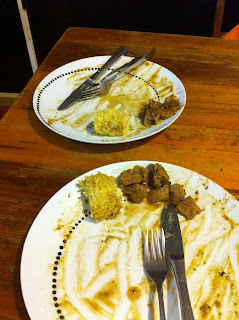 It's not much point eating it if it tastes that bad and I suppose it's not wasted when we have dogs!
It's a bit of a problem for us really, because we are getting to the stage that we can't eat conventional food. Have we become so accustomed to eating our own or other organic produce, that we can't stomach other foods. It's been a long time since I have "enjoyed" junk food, but to not even be able to buy the usual supermarket produce is another thing altogether! Oh well, I just suppose we have to convert all our friends and family into buying good quality and healthy food!
Recently our daughter brought out some left over roast pork - this was conventional pork that she had cooked a few days earlier. Our family don't believe in wasting food, so she brought it out for me to do something with. I cooked up a kind of stragonof thing, with fresh mushrooms (well, they were frozen ones that we collected previously), garlic and parsley (from the garden), onion and finished with some of my lovely fresh cream. I served it with pasta. Well the sauce was really nice, but I could not eat the pork! It really did not taste very good!

It's a bit of a problem for us really, because we are getting to the stage that we can't eat conventional food. Have we become so accustomed to eating our own or other organic produce, that we can't stomach other foods. It's been a long time since I have "enjoyed" junk food, but to not even be able to buy the usual supermarket produce is another thing altogether! Oh well, I just suppose we have to convert all our friends and family into buying good quality and healthy food!
Friday, September 23, 2011
Free Range Pigs
We have just returned from a weekend workshop about starting a free range pig business. It was good, and we learnt a lot about pigs, but it was only necessary for us to do it because of the Intensive Pig Industry. We can run cattle or sheep or goats on our property, but to run pigs, we need to have a Certificate. It shouldn't be any different to cows, as we want to run them in paddocks and use the same grazing principles for them as we do for our cattle, but unfortunately, the "powers that be" don't think the same!
There is a code of practice that states that pigs should be allowed to act as pigs. The only way this can be done is to allow them to free range - not in a bare dirt paddock or a shed! And....I must add, that the supplementary feed should be placed in a trough, not just on the ground! Pigs do eat dirt (incidently not deliberately) as they like to dig in it, but they don't NEED to eat it.
Pigs eat a lot of grass and this will always be their first preference, so it's essential that they have free access to it! They also need to eat a grain supplement, which will include meat meal. Pigs are omnivores and so they do eat grain, grass and meat. Just like us - we need a balanced diet too! The big difference with us, is that we need to make sure that we don't eat too much of a good thing!
If you were to eat true pasture raised pork and conventional shedded pork in a blind taste test, you may think that the stronger flavoured pork is the free range. This is because one of them will have a "gamey" taste. True free range pork tastes fantastic (and simple) - it is not strong flavoured at all! The "gamey" flavour, which you will find is the shedded pork, is not a wild taste, but a taste of their own effluent! So, next time you want to try pork, PLEASE try a pasture raised or organic piece of pork to try and see if you can taste the difference!
Another story I must tell.......at the workshop, we where in the paddock with some young gilts (females before they are mated) and were standing around in a circle talking. One gilt, who wouldn't allow us to pat her, came over and "sat" in on our conversation! About 6 of us humans were standing in a circle and she was sitting on her haunches in the circle and just being "part" of the discussion. Pigs are very intelligent and should NOT be kept in pens in sheds.
Friday, September 9, 2011
Pig - using everything but the Oink!
Well, the title is misleading, but I like it, and one day, maybe I will........
We recently killed a pig and I decided to have my first crack at bacon, make some brawn and try some things that we don't normally eat. We had some of the liver, which we don't normally eat and I don't think we will bother again! It's a lot stronger than beef liver.
Today I had my first try of the brawn.....I will be doing that again! It's made from the head and the feet of the pig. I did half a head and two trotters - next time I would add more meatie stuff like the hocks or shoulder chops, but even as it is it's really good and it just set so perfectly. The addition of the trotters is to add the extra geletin that's needed to make it set and hold together. When I cooked the brawn I included both ears, but took them out before making the brawn. I wanted to try something with them, as I'd seen a recipe in a recipe book - Crispy Pigs Ears. The recipe didn't quite work, but it was very good.
The ears are sliced and then crumbed and fried and finished off in the oven. My crumbs didn't stick but the idea is good and I will be trying again to perfect it - just need to wait until we kill another pig. I served the ears with some wilted greens - shallots, asparagus, snowpeas and warrigal greens. Everything was home grown - well, the warrigal greens were picked out of the paddock. They are a native green vegetable and is used just like spinach. It grows on creek and river flats naturally, and is really nice. It's similar to spinach in that it should be cooked, although I have used it in pesto and salads without any dramas. I think you need to eat about 4 cups in one sitting to be a problem, so that's not likely!
If anyone wants the recipe for Brawn or Crispy Pigs Ears, you will have to ask for it. I will post a photo of my brawn as it looked really good!
The bacon was also really good! I didn't smoke it as I don't have a smoke house, it was just cured in the fridge for a couple of weeks and then I sliced it. So simple and I don't know why I haven't done it before. My brother just visited and brought me some home smoked ham and bacon, so I will enjoy comparing my bacon with his!
Wednesday, August 31, 2011
Mushrooming
Spring is sprung and we have had some lovely rain! This also means mushroom time! I went out yesterday afternoon and collected about 1kg and then this morning another 1/2 kg for breakfast! Will go again this afternoon, and maybe for a couple of days, but as it warms up, they will finish up. Some people are a little concerned about eating wild mushrooms and rightly so. However we have been eating wild mushrooms for many years - I never even liked mushrooms until my husband brought home a hatful one time after we were first married. I'm in Central Queensland and I know I can eat these mushrooms, but if you live anywhere else, PLEASE check with someone who knows before you eat any wild mushrooms. The main thing to look for is pink to brown gills - if they are white under neath, don't even think about it. There are two types of mushrooms that I know of that are brown under - one you can eat and one you can't. If they are brown to goldie coloured on the top, and usually a little pointy, DO NOT eat these ones. The edible ones tend to be almost flat and white on top. Sometimes they can have a little colouring on top, but not too much.


If your mushrooms look like these, they should be pretty right. Last year we had heaps and I made mushroom soup, mushroom sauce, froze some and just generally we ate mushrooms for a week! I will dry some this time, as I think that might be better than freezing. They go very soft and mushie when frozen, but are great for soups and stews. I'll put some of my mushroom recipes on the Recipe Page.
Goodluck! And remember, don't touch them unless they are pinkie brown underneath and not gold on top!
Subscribe to:
Posts (Atom)