Thursday, July 14, 2022

Winter garden update

Well, it's a miserable, cold and blowy day outside today, so I thought I'd do a quick walk around the garden to take some photos. It's much more pleasant looking at garden photos inside the house than actually doing some work in the garden! I've been very lethargic of late and haven't really been very inspired for a while now. Covid taking me out for a couple of weeks has not helped, but I'm on the mend now and really need to get my mojo back. 

Kim and I dug up one section of the turmeric bed and I think the rest may end up staying in the ground! We got so much turmeric. I processed 600g into some fermented turmeric paste, and then I don't know how many kgs have gone into the dehydrator. I'll weigh the final powder product. This turmeric seems less yellow than stuff I've grown in the past - perhaps a different variety? I also wonder if the previous owners have ever dug it up, as there was a massive clump. I will offer the remainder to anyone in the permaculture group to come and get some if they want.


My Bean Teepee. Kim made this for me the other day. I've planted a third each of Good Mother Bean, 7 year bean (thanks to Ruth for these) and Scarlet runner beans from Sophie. 


Kale at the front and some walking onions at the back.


Garlic, lettuce, cabbages, spinach, marigolds, red onions. 

Potatoes. These are growing really well, I just hope that they are as productive under the hay as they are above the hay. Garlic growing alongside the potato patch.


Tatsoy in the foreground and some spinach behind it. Further along, you may see my baby leeks near the tap. 


I had a go at planting some chickpeas. They have not grown very well. Not sure why, but maybe there's been too much rain.


The pumpkin patch keeps going. This came up by itself soon after we came here. We're currently eating some of the produce from it and there's more growing. 

Beans at the back and weeds at the front. The beans have not done very well, once again, maybe too wet!


Daikon. I planted these on the area where the pigs had been. They've grown really well and we've been eating a few. I put them in stews, stirfry's, salads and I've also recently pickled some. I did a vinegar pickle, but will ferment some also.


Shallots on the left, celery behind and perennial spinach on the right. We just pick these as we need them.


Warrigal greens, with lettuce going to seed behind. These lettuce had resown previously, so they'll just keep on coming on. Red cabbage seedling at the front. I bought some cabbage seedlings as none of my seeds struck. They haven't done terribly well. I got a good strike with cauliflower and brocoli seeds, but they have not done so well once planted out. Some rodent has mostly eaten them off.


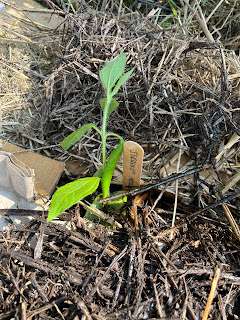
Tomatoes that I have intentionally planted have not done so well, but this one above is a huge cherry tomato that has been growing through one of the grapefruit trees. The photos below are also self seeded and I'm yet to discover if they are yellow or red ones.


So that's some of my garden in pictures. I didn't take photos of the  citrus trees that have been producing the most amazing citrus. We have one tree of oranges left (two have finished), still have 3 grapefruit producing (why would anyone need 3 grapefruit??). A lemon tree is loaded and we're still picking the odd lime. The fig trees are getting leaves again. One banana has formed another bunch. The pecan trees have defoliated. My strawberries are struggling. Sweet potatoes are spreading throughout the orchard. I have a small avo tree, a chocolate pudding fruit, pawpaws, passionfruit vines and so much potential food! 

Saturday, May 14, 2022

Cassava

Anyone that is into permaculture and lives in the tropics, will have heard of cassava. It's a well known addition to a food forest and is used for it's edible tuber and to chop and drop. When I used to do the markets in Rocky, Frankie next door to my stall, used to sell it and I'd often be given some to take home, but by the time I got around doing anything with it, it was a bit dried out and to be honest I didn't think it was worth the bother. However, recently we visited a friend in Monteville and had a tour of her food forest. She urged me to take some, so Maitland pulled up a heap of roots. We ate some that night cooked like mashed potato. I didn't peel it properly as it was very fresh and soft. That was a mistake, as the outer bark remained quite fibrous and didn't mash very well, but otherwise definitely a good substitute for mashed potato. I decided to make some flour out of the rest of the roots, so this time I googled a how to video.

Peeling the root - just cut into it with a knife and the outer layer comes off quite easily. I didn't actually weigh the amount I started with, which would've been useful information.


After washing all the root pieces, they are chopped small to enable processing in the thermomix (or blender or food processor). Water is added to the processor first and then blitzed to quite a fine dice - almost paste like. You can't add too much water - it comes out at the end anyway. You can also grate it by hand on a fine grater, but that sounds like way to much effort for me.


I followed the video and did the first strain through a sieve, but next time I would just strain the whole lot through cheese cloth a little at a time, giving it a good squeeze. You keep this cassava to cook with later on. 


I made bammy with this strained cassava. I made little ones, as I had trouble getting them to stick together. 


Take note of this bowl of liquid above, as this is what it looks like straight after straining.


Bammy is twice cooked. I'm assuming that this is so that they stay together better. Then, when you soak them in the coconut milk for the next frying, they don't fall apart. 

I really liked the bammy, which we had with a Jamaican Goat curry, but I also think they'd work as a dessert with some honey drizzled over them.


Now, back to the tapioca flour, because that's what it's called once it becomes flour. The bowl of white liquid, once it sits for an hour or two, settles out. You end up with some dirty looking water sitting on top of a solid layer of wet starch. If you've mixed tapioca flour with water to thicken something and not put enough water in, you'll know what this white layer is like. It's really thick! (I forgot to take a photo before I poured off the water, which incidentally was very easy to do). The bowl was full, so you can see how much starch you get from all that cassava!


I dried the cassava paste in a 100 degree oven.


After it was dry, I gave it a whizz in the thermomix to make it all fine and fluffy and then I did use a sifter to make sure there were no lumpy bits. The final product was 205g of tapioca flour.


We have one very small cassava tree growing already, but I took some cuttings to propagate some more. I would like to have access to a lot of this food source. It's very high in starch, but I do wonder if once you take the flour/starch out, whether the resulting fibre is just fibre. Fibre is good for the gut. Cassava is also a resistant starch so easier to digest than some starches. I'd like to play around with the pulp and maybe make some different flatbreads, maybe by adding eggs and seeing if I can make them rollable. One thing is for sure, it's easier to make tapioca flour from scratch than wheat flour (growing and harvesting wheat is very difficult on a small scale) It'd be nice to have a good easy bread substitute that we could grow here.


I've done some cuttings (3) straight into the pot and the other 5 pots have a horizontal piece under the soil. I've grown them like this in the ground before - we'll see which one works best. If you've got any recipe or other ideas for cassava, please comment below.

Wednesday, May 4, 2022

Biodynamics

We have dabbled with biodynamics for many years. For a while at Anabank, we were involved in some carbon trials with other land managers, where we were measuring the amount of carbon that we were building using various methods. It was some time ago, and I can't remember how many people involved, but we were doing biodynamic spraying and another bloke was making and spraying compost tea. We were both cell grazing. It didn't continue long enough to see how much carbon we were building, but I do remember that we tested the spray liquid - ours was BD500 and his was compost tea. The BD500 had better biology than the compost tea. So for those of you that think Biodynamics is just woo woo stuff, it's not. It is grounded in science (and astrology or, is that astronomy).

If you want to read a lot more than I know about Biodynamics, please check out these two sites. This is an American site and this on is an Australian site and the one I am a member of.

The way I understand it, is that it's based around preparations (preps) that are made through a composting process and are a bit like homeopathic, you don't need a lot of them to do a job.  For example BD500 is a prep that is mixed at the rate of about a handful in a bucket of water and then sprayed or splashed by flicking out droplets over your entire garden. It's the essence of a fertiliser, rather than a fertiliser spray.

We have recently put down two different preps. BD500 and Cowpat Pit (CPP). CPP can be done any time of year, however BD500 is done over the winter, so is usually put down around Easter and lifted in early Spring. The CPP takes about 3 months, but will depend on the temperature and conditions at the time. It's easy to keep an eye on as it's only in a box with a bag and tin cover. The horns are buried, so we hope for the best with them.

BD500 is just cow manure, stuffed into cow horns. The cow manure should be from lactating biodynamic managed cows. The horns should also be from females, but ours are a mixture. The manure is from lactating cows, but we haven't been managing them biodynamicaly.


Manure collected from my milking cows. Four cows produce a lot of poo. The horns we got from the Biggenden abattoir. Back in the day when we were regularly going there, we asked them to keep some. It cost us a carton of beer. We did lose some horns because the dogs found them once and chewed a few up.


Me (Lucy) filling the horns. Gloves are optional......


Kim placing the horns in the ground. He dug the pit with the tractor first. We read in a book by Peter Proctor, to "plant" the horns and to have soil around them. When we've helped in the past, the horns were just piled in, but we thought we'd do it this way.


You need to back fill with soil. We put the bag down to hopefully make it easier when it comes time to retrieve the horns.


We had space in the hole and still had manure left so we thought we'd make some CPP. We went down to the shed where Edmund was building a dog cage, and asked him for some timber so that we could frame up for a box to contain the CPP. He quickly put together what we required. I love seeing a craftsman in action! 


Back up the hill to the garden and the box was a little big for the space left. I also love seeing a man on the end of a shovel. Men can handle a shovel so much better than a woman!

The box doesn't have a base, as it needs to connect to the earth.


Mixing the CPP. Manure, 200g crushed eggshells, 400g basalt rock and we also added about 200g seaweed as I reckon that would go well.


I had previously bought the preps, as I had intended to make some of this when we first moved here. 


The 5 compost preps are put in holes and then a liquid prep is added - first in the two bigger holes and then sprinkled around the whole area. 


The area around the BD preparations need to be kept moist, like a garden. We've covered the horns with hay to help insulate them and we'll keep it watered and will keep an eye on the CPP to make sure the bag covering the manure stays moist.


I have done several intro to Biodynamic courses and read some books but am a long way from being very knowledgable about it. It's one of those things that you just need to start doing and learn along the way. If you would like to know more, please click on the links I gave above or just google it and then you can spend hours down the rabbit hole of the the www.

I look forward to writing more about it once we dig it up and start using it. Although, I do have a kg of purchased BD to use yet - I bought a mix of BD500 and CPP - it's called Combine Soil Preparation. And we also need to look at purchasing a flow form or stirring machine when we go to put it out. More on that when we get one.

Friday, April 29, 2022

Quick Update

I have very slow internet but thought I'd do a quick update. I've been busy lately in the garden and in the kitchen. Sometimes I wonder what I do all day, because there's always more to do. Who used the "retirement" word? We certainly haven't retired. They always say a little place has as much work to do as a bigger place, it just doesn't make you any money!! ha ha.

Anyway we're happy and healthy and not getting bored.

Kim helped me plant all my root crops the other day - carting soil and laying hay mostly, but it was good to have his help. It's almost time to plant out my seedlings for my fruiting crops. I plant using the phases of the moon and using this calender.  I will take some pics when everything is up growing!

I've been preserving eggplants and had a crack at a mixed veggie pickle using some home grown snake beans and some traded chokos. These will be interesting to try in another couple of days.

I swapped some chickens for some chokos and chillies and a pot of chives, so I think I did quite well.

These chickens have quite a story attached to them. One of my very good friends has a brother in law that is also an highschool Ag teacher. He took delivery of about 40 chickens two weeks early - at the end of term instead of the beginning. He needed to get rid of them and because my very dear friend was visiting at the time she thought I might like some......I got the lot. Next time she asks if I want some of anything, I think I'll say no. Alls well that ends well. Edmund quickly finished off a chook tractor he was making and we have managed to find homes for some. There were about 15 meat chickens, which I was quite happy to have but the 25 layer chickens are probably more than I need. I'll keep 6 for my son and family and 6 for us to replace some of our old girls and after this weekend, will have given the others away.

For those that follow this blog and also follow my facebook (Lucy's Farm Kitchen) you will notice that I haven't been on facebook since Easter. Some scumbag hacked my personal page and Facebook haven't completed their review, so I've been shut down. Not sure I'll get back on either. I don't really care for myself, but I did enjoy posting on my kitchen page (it's linked to my personal page, so was collateral damage). Anyway if you don't already follow me on instagram, you could give that a burl if you like. You'll find the link here: @healthyfarminghealthyfood

This weekend, we have a BD500 horn burial planned, so I'll post about that once we've actually got it done. 


Saturday, April 2, 2022

Trying to manage grazing on Serenity

Serenity, this beautiful piece of dirt that we call home was already set up for rotational grazing when we bought it. We kind of fell in love with the place and had bought it and moved here before we really took stock of what development there actually was. We knew it had been looked after, there were few weeds, and at least 20 paddocks on 50 hectares. What we didn't really think about was that yes it was weed free, but it was also pretty much tree free. That's not quite correct, as there are quite a lot of trees, but not as many as we'd like and in the places that we'd like. Especially when we start splitting up the milker paddocks with electric fencing. It's been hard to make sure there is enough shade for the poor girls! 

The other problem we have is the water system - or lack there of. There are a couple of dams - fenced into separate paddocks and just about every paddock feeds into one of these dams. So the main mob of cows have to walk down the hill to the dam for water. There's a few problems with this, that have really come to light over the summer. 

1. Ticks - we can't get enough rest around the dams to break the tick cycle, so we've had to resort to chemical treatment to get rid of them. Not what we want to do at all, but if we don't it then becomes an animal welfare issue.

2. Wet/muddy ground - we have hills, that have water flowing out of them. I'm not sure if it's just that we've had an exceptionally wet summer or whether it's always like this, but there are springs just flowing out of the ground. Lovely, but messy when it's where the cattle need to constantly walk to get to water.

3. Cows are lazy and won't walk to far, so when they come down the hill to the dam for a drink around mid morning, they hang around until mid afternoon before going back out. In this time, they just graze around the dam. The paddocks around the dams are too large and so this also encourages them to overgraze.

We have now set up temporary electric fencing around the dams and will only allow the cattle into sections, which means that when we move them to the next paddock, they then have a fresh area to go down to drink. One thing that has made this so much easier is kiwi tech fencing. It's an amazing portable electric fencing system. We use it to section off the dam, for the milking cows to break up the paddocks smaller, and for the sheep and goats - we've somehow managed to train them to stay behind 2 electric wires.

We are currently working on a farm plan, which I'll discuss when it's finalised, but we will put in a solar pump on the dam and then pipe the water to a high point and then reticulate back to each paddock with it's own trough. We will also do some Natural Sequence Farming work to hopefully stop some of the springs from just running down into the creek. The contours will spread the water out along the paddock. This will be a little tricky due to the steepness of the hills, but we'll do what we can where we can. 

The idea will be to make the contours wide enough that we can drive a buggy along, which will give us a lot more access over the property. Trees will be planted along the contour also. As we'll have to fence these off, this will effectively break up the paddocks so that we will get a far better rotation. 

I like the idea of planting a mix of trees - timber trees, fruit and nut trees and fodder trees for the animals. Hopefully we'll get started on some of this over the winter, although we need to start propagating some trees asap. I'll share our activities on here and through my instagram @healthyfarminghealthyfood. 

Moving paddocks - The cows are still getting used to us.

Kim attaching the kiwi tech wire to the existing electric fence.

Splitting the dam into sections


Tuesday, February 15, 2022

Travel - Serenity to Daylesford and back

We've just come back from an 8 day (lightening) trip through parts of NSW and Victoria. It was enjoyable, but the travelling time was tiring! We took 3 and half days down and then 3 days back. One of the things that really got to me was the lack of regenerative farming. I'm on various facebook pages and we only seem to mix with people involved in regenerative farming, that I assume that its becoming more and more common. Sadly, it's not!

I saw a couple of cattle feedlots, some industrial sheds housing chickens or pigs and lots of cropping land that showed a lot of sprayed out country. We drove down on different roads to those we came back on, so that's 7 days of driving and not seeing any regen ag! I sometimes think that things will never change, but I suppose I can only change/affect me, so it's not much point getting myself stressed about it. I'll just keep doing what I'm doing to try and effect change in others by example and education.

The Trip

Usually when we travel, we take our own food, but we didn't take much this time. I was foolish enough to think that the Regen message was well and truly being adopted and that eating places (pubs and cafes) would have some sort of grassfed options. Nope! Most of the serving staff when asked, just looked really confused - I may as well have been speaking a foreign language. Kim got embarrassed when I asked at every place, but if you don't ask, no one will ever get the message!

We ate out throughout NSW, even though our choices were not great. When we got to Victoria, and due to the segregation laws, some of us weren't "allowed" to eat out. We had booked into an airbnb in Daylesford so that we could cook for ourselves - so that was the best food we ate on the whole trip. Daylesford also had some good food choices in their organic shop and a nice little cheese and wine shop, so we could buy good ingredients.


A nibbly platter included some local grown and made foods and some organic cheese. The little bit of bread you can see in the middle was baked by the best bakehouse in Australia - Twofold Bakehouse.

Seeing as it was going to be Thursday when we arrived in Daylesford, I had pre-ordered some bread from Twofold Bakehouse. They only bake two days a week and the bakehouse includes a huge wood fired oven. One of the highlights of our whole trip was to watch the bread being baked. Edmund and Maitland actually helped to lay the cement for the floor, and Edmund is good friends with them, which enabled the invitation to watch. If you've never seen alot of sourdough loaves go into a wood fired oven to cook, then you've missed out on a treat! They had to go in pretty fast and then cooked so fast it was amazing! 15 minutes to cook a loaf of bread! Gosh and the bread tasted so good. I may have overdosed a bit as it did give me bread belly after a couple of days!!


We did take some sausages, bacon and eggs with us. Plus home grown tomatoes, mushrooms (that would've gone off while we were away) and of course some krauts. This was Maitland's meal not mine, mine was a little smaller.


We also did some foraging. We picked some (but not enough) black berries and apples around Daylesford and then coming back through Stanthorpe, we picked some more apples (below) and some peaches (above). I'll probably preserve most of these. These were on the side of the road, and I bet you the people living nearby, go into woolies to buy their apples and peaches.


We just about always travel with our camp stove and coffee pot so we boiled up a brew each morning. This was the last of our twofold bread.


We forgot to take a pan, so we bought one at a second hand shop so that we could cook some food on the way home. Left over sausages and egg pasta, with some veg and a jar of tomato sauce made a pretty tasty slap up meal. 

The biggest take home messages from this trip were:
1. Don't assume that the regen ag message is broad - and don't stop trying to influence and educate people.
2. Always take cooking implements and buy good quality food when you can so that you can cook it yourself and not get a belly ache or a bruised conscience! 

Monday, January 17, 2022

Serenity Update

I'm still serene! Still loving living in this beautiful part of the world. It's hot and muggy, but not as bad as CQ, and sitting out on the verandah typing this, is just so nice - catches the smallest breezes.

I have been busy in the garden over the last 10 days - planting, cutting grass and weeds and mulching some areas. Between Edmund and I, we've planted lots - either seeds or cuttings. We've been enjoying eating quite a bit from the garden - beans, green leafy things (salad and veg), herbs, daikon, asparagus and so many tomatoes which self seeded. I've currently got some in the dehydrator.


Bananas that we brought from Cherhill about a month ago. We do have other groupings of bananas, but it's one thing that you can never have too many of. They are really good for chopping and dropping for mulch.


Mulching with cardboard and old hay


Mulching a couple of pineapples. I usually just plonk the pineapple top in the ground, but over Christmas, my nephew Jack showed me how to do it properly. You may or may not know that you should peel off a few layers at the base and then stick the top in a jar of water. Roots will come out of the little nodule things and then you plant it out.


I bought some plants the other day from Green Harvest at Maleny and also the Maleny Co-op. This is a small Sunchoke, but I also bought Yacon, Cassava, Chinese Potato, Kiwi Berry (a miniature kiwi fruit that will hopefully grow here). I'm trying to get a good selection of perenial vegetables for planting in the Food Forest, which is what the garden/orchard area is rapidly becoming!

These delightful yellow tomatoes are providing us with lots of tomatoes. The grow to about golf ball size, so are quite useful. It doesn't seem right, but I will have a go at pasatta when I get a few more. Yellow Pasatta?


Turmeric was existing, but I planted some ginger, which is only just coming up - you may see it to the right of the turmeric. Then on the right edge is some leafy greens. We need to plant lots of these for salads, veggies and juicing (the boys are into juicing at the moment)


I discovered this the other day - not sure if it's a raspberry or a blackberry. I'll have to get some gloves so that I can train it to go along the fence, instead of sprawling all over the ground and outside the food forest area. I couldn't see many fruit, so I may need to look after this plant a bit better.

We are getting plenty of eggs, hatched out two chickens and processed 6 roosters that were given to us. We have the goats and sheep in movable electro netting and we'll probably process a few of them in the next few weeks as they missed out on getting rings on, so we'll do them before they get too old.


We haven't done any development on the farm yet, as we are sticking to our plan to do a plan first! Edmund has been busy setting up a calf branding race as we desperately need to brand and castrate some calves, before they get too big to handle. I'm not really sure what the bloke before us did as there is no facility in the yards for branding. 


I'm still enjoying my milking days and have been trying to get some cheese made. It's not easy in this humid weather as the cheese doesn't really dry out properly. I would wait for the weather to cool down, but I'm a tad impatient!

We collected some bunya nuts the other day and I processed about half of them. I still have some nuts ready to use, so hopefully they'll keep. We think we may have overdosed on them a little bit. We have been eating very low carb lately, and these are very high carb, so we're going to have a little break.


Bunya nut pesto with bunya nut crackers. The pesto was delicious, but I need to work on the crackers. Crackers were just boiled nuts processed with an egg and spread out to bake. Next time I'd add some seeds and some spices I think. They were very hard.


I dried some and will turn it into flour eventually. This is probably going to be one of the better ways to use them if the flour is any good. 

We had a great Christmas, with a few of the family here. We've had a few visits from others over the period too. Boxing day lunch we decided to do an Asado. One of my favourite ways to cook, especially when I have someone else to do the cooking for me.......


So, until next time - cheerio......