Sunday, March 21, 2021

Regenerative Agriculture

There is a person in this photo. This is what you get when you manage land correctly. this photo was taken in March, 2020 after good, but late summer rain, following a sustained dry period.

What exactly is regenerative agriculture? For many years, Kim and I have been saying that it's not good enough to be sustainable - why would we want to sustain a degraded environment? We need to be improving it. This is basically what regenerative agriculture (regen ag for short) is. It's improving the farming and grazing soils to a point that is even better than what they were before "modern agriculture". The "date"of modern agriculture is flexible - the Middle East, it may have been many thousands of years ago (around 10000), Europe, probably not quite as long, America - a few hundred and Australia is only young - since white man turned up, a couple of hundred years. We are rapidly desertifying our planet and a movie I watched a little while ago, suggested that we have 60 more harvests in America before the soil and/or water is gone.

Sobering......

The movie was Kiss the Ground and it's available to watch on Netflix - please watch it if you can. I'm currently listening to the audio book, which is available on Borrowbox - the free library for audio and ebooks. 

It's difficult to go into to an in-depth explanation of regen ag, and it's not simply organic farming. Animals are easy - they should be on pasture and free to roam - not locked up in yards or sheds. Cattle/sheep/goats etc on pasture only and managed in a rotational grazing/resting/mob stocking system.  Pigs and chickens on pasture (also rotational) and supplemented with grains grown by regenerative farming practices. 

Grain/pulse/seed growing is a little trickier. For many years Australian farmers have been changing over from "conventional" farming to zero till farming. This Conventional method is where you plough (till) the soil to get rid of weeds and to prepare a seed bed (similar to how most people prepare a garden bed). Zero till farming as mostly done in Australia, requires the extensive use of chemicals to kill weeds before planting. Sometimes this is done 4-6 times per year as the belief is that weeds are using up moisture that the future crop will need. The latest wisdom amongst regenerative farmers is that soil needs to have living plants in it all the time to retain moisture and enable the biology in the soil to become abundant. Tilling the soil (which is also why you should practice no-dig gardening) damages soil biology. The most common chemical used to kill weeds is glysophate and it destroys biology in the soil.

Tilling can damage biology, but it also releases carbon into the atmosphere. Living plants take carbon from the atmosphere and draw it down into the soil. Gabe Brown, who is featured on Kiss the Ground, has some great Youtube clips on this if you want to learn more. Another fellow is Mark Sheppard and his book Restoration Agriculture. While talking movies/books, Biggest Little Farm (on Stan) is an amazing example of farming regeneratively. I'll put some links at the bottom of this post, but be aware, you will get sucked into the rabbit warren that is youtube!

We are concerned about Climate Change, and rightly so.  The climate is changing and yes it's getting hotter (some places are getting colder) and yes there are more extreme weather events. Climate change is something that will be easily fixed and it's not really up to Governments to fix it. Waiting for "someone else" to solve the problem will take too long.  We as a human population, are doing the wrong thing for our environment - we are the ones that need to fix it. 

My thoughts are that there is really only one major thing we as consumers need and should be doing.

Change the way we consume - Food and Things

Food - support regenerative farmers where ever possible. It's really difficult to know if you are or not, unless you are buying direct from them.  The supermarkets will not be buying any of their food from regenerative farmers, it simply isn't being done at the scale that they would need to purchase at.  Not everyone is in a position to grow or make everything they need, so how you shop is very important. Please think before you automatically shop at the supermarket for food or other things that you can buy elsewhere. Yes, it may be more expensive (but not always) however, because you'll be spending less on stuff (as per the following paragraphs) you may be able to buy from smaller retailers or markets. This is also more likely to support a small local business, which is a win!

Stop consuming things that are made in ways that contribute to climate change.

Plastic - don't buy it (whenever possible). Don't buy food wrapped in it. Don't buy single use plastic items. 

Stuff - We just don't need excess stuff! Repair, and reuse. Try to limit buying new things - clothes, household furniture, electronics, everything. Think before you buy something - can you buy it second hand or do you in fact really need it? 

We need the world to have a lot of people doing good things imperfectly, rather than a few doing it perfectly. 

Grow some of your own food, support the local farmers market, order online from regenerative farmers. There are so many ways that we can do something. The sooner we get away from our reliance on the supermarkets, the better. 

The benefit of all this is that we will have a lot less pollution. Pollution is killing our oceans. Us humans aren't content destroying the land, we also want to destroy our water.

If we want to stop the use of fossil fuels to create power, think about the solutions. Is it better to use solar and batteries that require the use of rare earths, that are mined by child slaves? We can stop the use of coal fired power stations in Australia, but can we stop the use in other countries? Do we tell India and China that no, they can't have electricity? Is it better for poor people to cut down trees to provide the material to cook their food or perhaps use electricity or gas. Are we all going to be able to cope without air conditioning when the power fails, because there just isn't enough without coal fired power stations. Are we going to be happy with the price of power? Do we want nuclear power?

The solution isn't to completely stop the use of fossil fuels - this is also an almost impossible feat worldwide. Even if we did, we would still be losing carbon to the atmosphere - every time the soil is tilled, every time a tree is cut down, every time soil is left uncovered of plant material, carbon is released. Every plant that is actively growing, is actively storing carbon - drawing it out of the atmosphere and into the soil. It is the simplest and fastest way to reduce the carbon in the atmosphere and start cooling the earth. It is possible to feed the world farming this way - watch Gabe Brown and don't listen to Big Ag. The more plants growing, the more carbon is being captured and the biggest benefit of this is that more water will be getting stored in the soil!

There are a lot of components to a successful regen ag business and farmers/graziers shouldn't be demonised for doing the wrong thing. Everyone needs to be educated - the Governments, the farmers and the consumer. Starting with the consumer is something we can all do - we all consume - simply start shopping in a conscious way. Start supporting local regen farmers and stop supporting the big supermarkets! You can only change yourself, so work on that first rather than trying to push others to change.

Some Links:

For a definition and some good links: About Regen Ag

Gabe Brown Farming as an Ecosystem

Mark Shepard Restoration Agriculture

Biggest Little Farm Movie Preview

Sunday, March 14, 2021

NSW to Qld to NSW

We went back to Queensland for a bit.....to see the farm green and lush when most of Queensland is still in drought was lovely. It just shows that regenerative farming pays off. We have plenty of feed and even though we thought we had plenty of stock, we have in fact been quite lightly stocked! We're in a very good position going into our dry period, but a little more rain soon would cap it off! 

When we left our rental in NSW, we encountered a few issues with the Landlords - number one being that they are total tossers! Anyway, we are very lucky that we discovered the rental advocacy to help us out. The only problem being that we have to remain living in NSW until it's sorted, which could take up to 6 months, going through the bond court. Luckily we have good friends who have a granny flat and we can take the opportunity to travel round a little, using this as a base.

I have a few ideas for posts up my sleeve with regards to the farm and some of the regen ag activities we do or would like to do, so hopefully I'll get to that over the coming months. 

Moving cattle to another paddock. I was in the lead, Kim on another quad behind and Chloe on the horse with her dogs, doing most of the work!

Fixing up the fence - there's been a few odd jobs to do.

So much grass - This is green panic on a pretty ordinary bit of ground. You won't get grass like this unless you remove cattle and let the country rest. The most fertile soil is under trees, but people think you can't grow grass and trees! When cattle are set stocked (leaving them in the same paddock all the time), they keep the soil under trees denuded, because it tastes the best. Allow rest and grass grows, and yet, too many graziers kill the tree thinking that will solve the problem.

We put a contour in quite a few years ago - we would do it differently now, but this was mainly designed to help run water into a dam, so it's not really a contour, but a drain. It's working like a swale though, as it holds the water up and lets it soak through to the other side - good grass on both sides.

Another paddock with plenty of grass - this is looking out the car window.


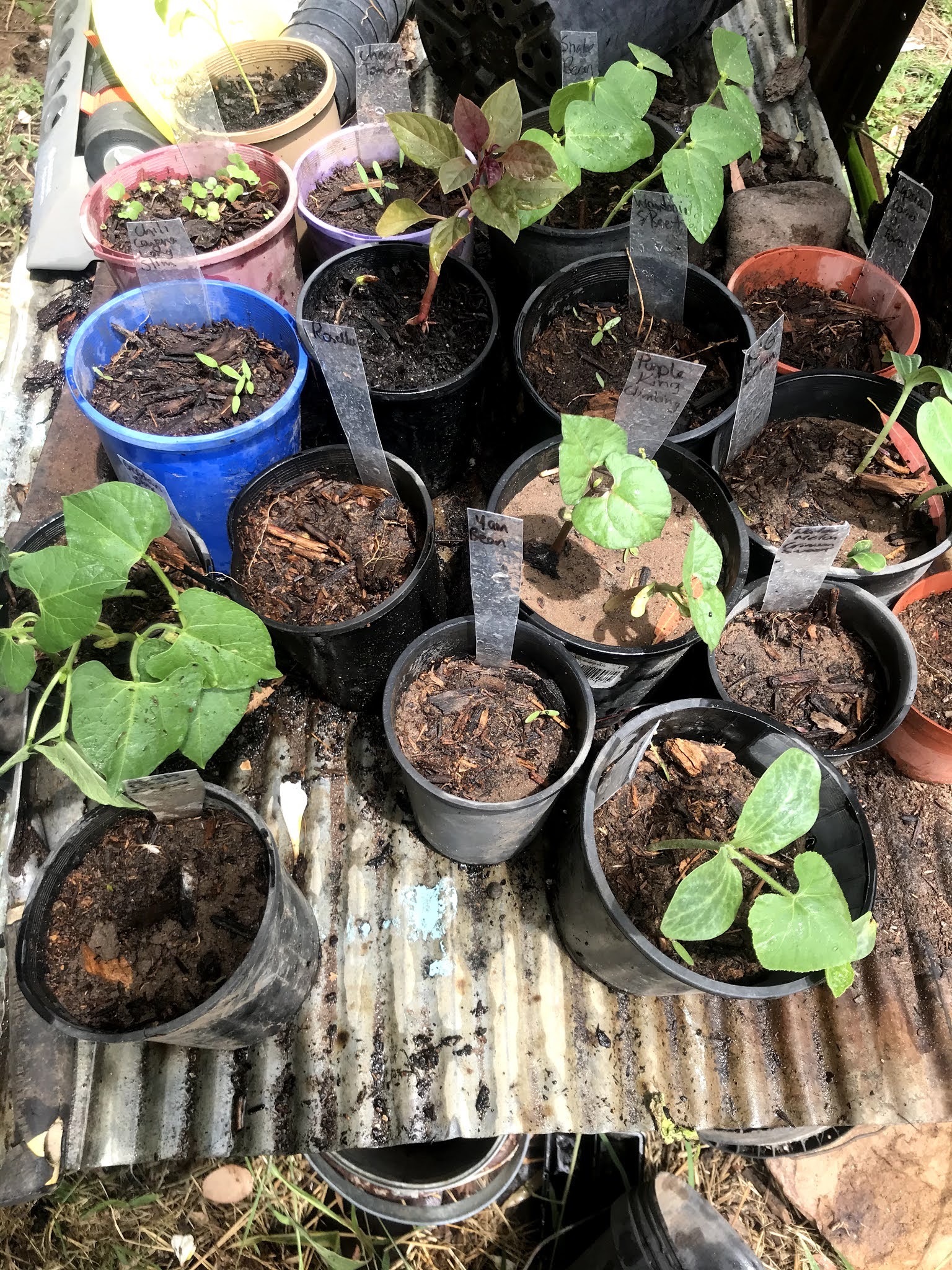
Seedlings that I've planted as soon as we came back - for planting in Chloe's garden.


Thursday, January 14, 2021

Another ending on the way

It's now the beginning of another year and as most people do, I am reflecting on my previous year. I expected to have lots of time this past year to do so many things. One of them was to blog a lot more. As you know, this didn't happen. So what has happened.....

I have had a wonderful year being a grandmother! My granddaughter - the first of many grandchildren I hope, is a delight. I have so enjoyed becoming part of her life and I'm really hoping that the relationship we formed this year will continue, even though we won't be seeing quite so much of each other now. 

From the moment we arrived in Canberra, I started trying to work out ways to meet people - I wanted to find like minded people and I succeeded. One of the first things I did was a workshop about food and making better decisions about sourcing and eating ethical and healthy food. I met a couple of people at this workshop that I kept running into and if we were staying around longer, would certainly be very good friends.

I then got involved with the Southern Harvest Association. First buying fruit and vegetables, then becoming a subscriber to their CSA box scheme, becoming a volunteer and finally a part time employee. But the best part about being involved with SHA are the people I've met. Some of who, I'm going to be very sad to have to say good bye to. I have found a community here and it's something that is quite special. 

I here some people say that 2020 was a terrible year, and yes Covid 19 has been terrible and caused a lot of hardship and sadness for many. However 2020 for me has been a really happy time for me. I've learnt to take life a little easier, to stop and smell the roses! I've had the time to cook lots and to fulfil a dream of writing a recipe book. I've been working on a Permaculture Design Course and Teaching Course, which I have finally completed the assessment for the PDC - took a little longer than I thought! Now I need to start work on the teaching component, which will involve actually teaching someone something about permaculture so that should be fun (and challenging). We went to Victoria a few times, in between covid lockdowns, to visit our son Edmund, which was more often than if we had of been in Queensland all year. I took up knitting - something I learnt as a child but have never really done much. I made many beanies, a vest and a poncho, mostly using local alpaca wool. There is too much to list - it's been a very full and happy time!

So even though this is only the beginning of the year, it's the end of our time in the Canberra region.

We are all moving back to Queensland soon and so a new phase will begin.....

Here's a few photos from this past year.


We met a wonderful pig farming family and have spent quite a bit of time with them. This photo was taken in mid-winter - we enjoyed experiencing a real winter!


I managed to plant a fairly successful garden - we've eaten something from it most of the year and will be leaving lots for the people coming after us. Although, I'll be going home with garlic, potatoes and carrots - and whatever fruit has ripened in time - apples, nectarines, pears and plums still to ripen.


The adorable one helping me plant tomatoes - which are all still green, but will hopefully start ripening in the next few days.


We even got to spend some time hiking. This is Molongo Gorge, ACT.


Sunday, September 27, 2020

Spring is Sprung

The spring equinox happened this past week. I didn't even know the date until last Sunday when we got invited to a Spring Equinox party. But I have certainly noticed the rapid move from Winter to Spring. The last few weeks it's been noticeably warmer and the days are longer. The grass has turned from a dull shade of bleak to a vibrant green. And yes, we have had rain, but we had rain all through winter and it stayed bleak and miserable. I might also add that this weekend has been an exception to Spring. Winter came back for a few days and may be around for a few more yet. Its nice to be in a place where we can experience all four seasons.

In Central Queensland, we have 2 summer seasons - a dry summer and a wet summer. We do have a few cold days in the middle there, but after being down here what we called winter is not really winter! 

My garden has been a bit disappointing - I was just too late getting planted before winter and so everything just kind of grew in slow motion (except the garlic, it's done alright). The broccoli, brussel sprouts, some of the kale and some of the cabbages went to seed as soon as it warmed up. I've been eating them, but just didn't get as much as I would've liked. The brussel sprouts were a total fail and I'm still waiting to see if some of the cabbages will heart up.

This was a recent harvest, which I turned some of it into a spring garden kimchi with a friends purple cabbage. I used the recipe from The Basics and it's still fermenting - should be ready in the next few days.

broccoli, dandelion, carrots, leek, green garlic, turnips. All but the broccoli went into the kimchi with the red cabbage behind.


I've prepared two new beds in the garden. I didn't want to plant anything too soon because we can still get a frost - apparently late October you can still get frosts! I will plant carrots, beetroot and potatoes in the next root planting window.  I did plant out some silver beet about a week ago. It'll be okay as it can handle frost. I'll wait until November before I plant any tomatoes, zucchini, eggplant etc. I'll have to find out what else I can plant now, but it won't be much.

This is what's in the garden at the moment.

Garlic, kale, cabbage, carrots, onions, lettuce

Snow peas and broad beans

Broad beans - they've been flowering for ages, but no beans yet.

Some of the broccoli that's still shooting, red curly kale, garlic, and in the middle are my new little silverbeet.

I have another bed with some leeks, cabbage, broccoli sprouting, and strawberries. Also all the trees are flowering, so it's very exciting to anticipate what stone fruit or nuts or apples or pears I'm going to have. 

I do look forward to gardening back in Queensland and it's funny to think that if I was at home now, it's our main growing season and yet down here, it's over summer that we grow the main crops. Everything does seem to grow faster here - especially the herbs! They are doing really well. Let me know what you are growing at the moment. 


Sunday, August 16, 2020

Norma's Salad Dressing

A plate of fresh crayfish, a loaf of good bread, a light salad and delicious dressing. What better meal will you find anywhere? It's certainly Kim's favourite meal and all he wanted for his 40th birthday was to sit down to a feed of crayfish and a beer. We were living in Mackay at the time and our very good friends in Western Australia, who also happened to be crayfisherpeople, organised a special delivery. Frozen and boxed with dry ice, the crayfish survived the flight from Perth to Mackay really well and were still frozen on arrival. 

I can still see him sitting at the kitchen table with crayfish, bread and butter and a beer. Bliss!

I'm not sure how many Christmas's we spent in WA, but quite a few. Kim's mother, sister, best/oldest friend and extend family live in WA. His brother moved to Qld and Kim followed soon after. 

Christmas is peak crayfish season and as we had friends fishing, and so did Norma (Kim's mother) we always manage to have a feed or three of crayfish when there.

Norma is a fantastic cook and is probably my greatest source of inspiration in my food journey. One recipe of hers that stands out above all is her French dressing. She was taught this and many more by her french brother-in-law who I think taught her a lot about cooking too. Australia in those days (Norma is 94) was very much a meat and 3 veg type cuisine, and that was often salt meat as there wasn't too much refrigeration.

A crayfish lunch usually started off with Kim at the kitchen sink cleaning the crays; me making a salad and Norma making the dressing. This was a process I watched many times but never really recorded, which I'm really regretting now. On a recent visit, she actually showed me the recipe but it doesn't represent how she made it. 

I think I've successfully recreated the recipe as I remember it. The picture below is my recent attempt to serve with prawns and fresh sourdough bread. I made this one in a mortar and pestle and I think it worked really well. The photos that accompany the recipe where taken a little while ago and I used a knife and board as I really wanted to do it as Norma used to do it. You can use just about any vinegar, but a white wine vinegar is probably best. I used my apple scrap vinegar and frozen lime juice the other day. I also used half home made and half dijon mustard, so please feel free to try with what you have on hand. In the photos further below it looks like I used red wine vinegar, so really anything works. The main thing is that it's a thick almost mayonaisey type dressing.


Normas Salad Dressing

Ingredients:

4 Large cloves garlic

Pinch of salt

4 teaspoons french (dijon, seedy, homemade) mustard

2/3 cup good olive oil

1/3 cup vinegar (white wine, apple cider, apple scrap, kombucha, jun)

1-2 teaspoons lemon or lime juice (taste as you go)

Method:

Crush the garlic with the salt - either by hand using the blade of a knife or a mortar and pestle


Scrape this into a jar. I'm sure Norma used to add a little oil before adding the mustard, just a teaspoon full. Then add the mustard and mix really well, so that it is kind of creamy.


Add the oil, a teaspoon full at a time, mixing continuously. Remember that you're emulsifying it.
Then mix the vinegar and finally the lemon/lime juice. 


It does make a big batch so reduce amounts if wanting to make a smaller amount. It does keep fairly well so during salad season, a big batch isn't such a bad idea. You don't need to eat it with crayfish - it's perfect on any sort of salad!

Please let me know if you give it a go and it works. And of course if you think it's as delicious as I do.

Sunday, July 19, 2020

The Basics - my basic recipe book

I've had a goal to write a recipe book for many years. One Christmas I did one for all my siblings called "Enjoy". It had a few of the recipes that I liked at that time and was printed on my home printer. I can remember the cover - it was a black card with the word Enjoy written in gold card on top. I think some of my family members used it for a while. Sadly I didn't do a copy for myself and have long since changed computers......

Many ideas for books have come and gone over that time. One idea I got when my daughter moved into her own home and started cooking was to write a book dedicated to beginning cooks - with a title like "help mum, how do I cook this....". Another idea was to write a seasonal book - working through a year and cooking based on what was growing in my garden (I still like this one....)

Then late last year, I decided that I wanted to write one with some of the recipes I do all the time. This would be a record for me, but also to hand out to my kids as they are all starting to get into the cooking from scratch principle. I had decided on an ebook, so that it could be on a mobile device and able to be used anywhere. It's taken me a while to sort through what I wanted to put in and what wasn't really necessary or useful, but I've finally done it!

I've called it "The Basics" as it is a compilation of my basic staples. Things I cook often or if not often, seasonally.  This is a list of the contents:
Table of Contents

I used a program called Blurb to design an actual ebook, but have not been happy with it, so have decided to settle for a PDF format for distribution. You should be able to save this on your phone/tablet (iBooks for Apple users, but not sure for Android). You can click on one of the links below to download using google drive or drop box.

I have used my own photos. I haven't included nutritional information. I occasionally included the  number of serves.  I have recipe tested but as I often change things around, I encourage you to do the same. Change and adapt however you want. It's not a professional, glossy publication. It's raw. It's Basic.

I decided not to actually charge anything for this book. I did contemplate it, as I thought I could then put the money towards my next book - maybe I'd engage a photographer for that one!

I really want people to use the book. Have a go at making more things from scratch. Be prepared to spend a little more time in the kitchen. Plan how you can incorporate the recipes into your everyday life.

However, if you find that the recipes are useful and you feel that there is some value for you, please consider to "Pay as you Feel".  The bank details to do this are at the end of the recipe book, so if you get to the end and you are so inclined, you can direct deposit a small contribution. This will be greatly appreciated!

Links for Google Drive or Dropbox:

Google Drive - The Basics

For an iPhone/iPad: After opening in the app, click on the 3 dots up the top left hand corner, scroll down to "open in" and select iBooks.

Drop Box - The Basics

For and iPhone/iPad: After opening in the app, click on the 3 dots and select "Export" and then "Copy to iBooks.

For Android, you'll have to work it out yourself, sorry.

And after all this, I hope you can access it and if not let me know and I'll have another crack at it! But most of all,

Enjoy......


Wednesday, June 10, 2020

Travel allowed again!

Yay, travel is allowed again! Well not to Queensland yet, but NSW and Victoria have loosened up. We traveled to Victoria last weekend to spend time with our 2nd Son. It was a wonderful weekend, although very cold!

no, not snow, just frost! Yandoit about 8am.

It was quite a foody weekend with foraging, preserving and of course eating! 

The weekend started with milking a cow. Edmund and his partner Katie, are in a milking co-op, which means there's a few of them that share the care and the milking of a lovely jersey cow. A bit of a challenge for me as the cow is not contained and when she has had enough she will just walk away! I was on one side and Katie was on the other side milking so she was fairly patient considering! We got enough milk to make some feta cheese.

Then Saturday morning started with a walk over the mountain to pick olives from a nearby olive grove. I'm hoping these will be better than the ones I did last year. I've got a bucketful of them so they better be. I'm also going to try a different method. 

Katie is a baker and Saturday she went off to bake bread and came home that night with mushrooms! Someone had given her a huge basket of safron milk caps. I hadn't tried these before so that was something new. I suggested drying some to preserve them, but Edmund wanted to pickle some, so we did both.

They look like little fish!
Drying the mushrooms above the wood stove. Hearty veggie soup in the big pot and carrot tops cooking in the frypan - Edmund cooks these so well and where a nice crispy topping for the soup.
Mushrooms, brought to the boil in vinegar, drained and then packed into jars with herbs and olive oil.

Sunday morning we went into Daylesford markets - bought a cabbage which I krauted this morning. I haven't seen any cabbages around our markets yet and I'm not sure mine in the garden are going to amount to much! I need to make more but could only do a small batch as my big crock got broken travelling down here. Anyone know of a good place to get another one - maybe a locally made crock??

Monday found us foraging the tale end of hawthorn berries and rose hips. I'll dry them both for tea, but will also have a go at this spiced brandy - purely for medicinal purposes! I have a few persimmons left from a few weeks ago which I can use up in this as well. We also made some hawthorn and fejoa jam from some fejoas that had been gifted. Hawthorn have a lot of pectin so we thought that they would work well with the more pectin challenged fejoas. You can read more about the goodness of hawthorns here and rosehips here.

Fejoa and hawthorn jam

Hawthorns on the tree - the leaves have all gone but still plenty of fruit.

Rose hips - same deal, the leaves are all but gone.

I took some goodies and brought back so many! But the best part was spending time with such beautiful people! It's just a shame that it's an 8 hour drive.